Why Process Matters to the Developers, Architects, Project Managers and Cost Consultants who Rely on Certainty.
On a live fit-out, good planning and clear information keep projects moving. See how Built applies ISO 45001, ISO 9001 and ISO 14001 from tender through to handover.
The real challenge of a retrofit is delivering a higher performing building while it’s still operating. A wall may need to come down while people work next door. A luxury gym floor may need full refurbishment while members continue to train. Mechanical and electrical services may need upgrading without disrupting occupants’ work day.
Process is key to understanding the risks, planning the sequence of works, controlling information and making sure every person involved understands their role.
Emmanuella Asantewaa Twumasi, Sustainability and Business Integration Coordinator at Built, has a unique vantage point. While she's not the person with the hard hat on, carrying waste into segregation bins or measuring twice and cutting once, her role gives her visibility across the planning, controls and processes that support delivery just as much as the lads on site.
From tender stage through to handover, Emmanuella understands what’s behind consistent project delivery and why these systems matter to the developers, architects, project managers and cost consultants who rely on certainty.
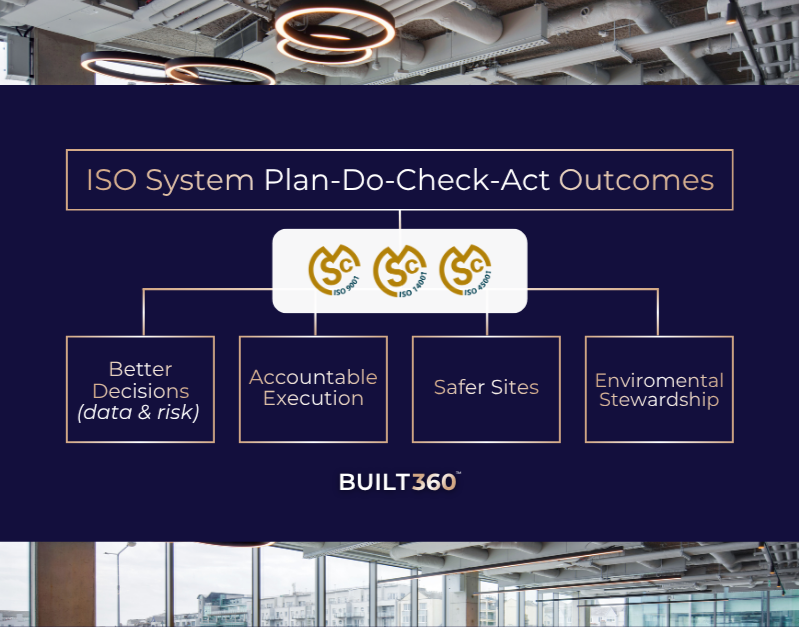
She’s been closely involved in Built’s quality, health and safety and environmental management systems and how these established processes are brought together within the BUILT360™ methodology, underpinned by ISO 45001, ISO 9001 and ISO 14001 certification.
As Emmanuella explains:“It’s not that the systems were going to show us how to do things. They came to check the system, what we do and how we manage all of that.”
The ISO framework gives additional structure to what was already working, making it visible, measurable and repeatable.
1. The Nonconformance Register
Different construction firms have different ways of handling problems when they arise on site. Sometimes it is a quick conversation. Some will show you a WhatsApp group with photos dropped in chronologically.
Within the BUILT360™ methodology, Emmanuella and the team favour a formal system. Every issue that arises is logged in a non-conformance and corrective action register. It is documented, the root cause is identified, corrective actions are agreed and, most importantly, measures are put in place to prevent the same issue happening again.
"If you don't have that formally documented, you won't remember what happened three months ago and how you resolved it," Emmanuella says. "But when you have it officially documented, that's a good thing."
At the end of a project, senior management reviews these issues in formal meetings. They're filed with the project. Auditors examine them, client feedback is gathered and analysed, and lessons learnt are documented and feed into future projects.
“This creates accountability, yes, but it also creates institutional memory.” - Emmanuella
You always know your client is happy when they ask you to design two more projects. We’ve just completed a second Liberty IT project in Galway and are commencing another project in Belfast .
Patrick Wilding
Design Lead, CBRE Design Collective
Delta Airlines
"Lorem ipsum dolor sit amet, consectetur adipiscing elit. Donec orci diam, lacinia ut massa tincidunt, faucibus commodo."
Walt Disney
Lorem ipsum dolor sit amet, consectetur adipiscing elit. Donec orci diam, lacinia ut massa tincidunt, faucibus commodo.
MetLife
Lorem ipsum dolor sit amet, consectetur adipiscing elit. Donec orci diam, lacinia ut massa tincidunt, faucibus commodo.
2. Risk and Method Statements
Let's say the project involves demolishing a wall. A risk and method statement identifies what tools will be used, how the work will be sequenced, what hazards exist, what controls will mitigate those hazards, and what time of day the work happens so noise doesn't disrupt occupied floors.
"There's no activity that gets done on any of our construction sites without a risk and method statement," Emmanuella explains. This is standard across the methodology, whether it's a major structural intervention or what looks on paper like a minor task.
“It forces frontline thinking, makes assumptions explicit, and catches problems in planning.” - Emmanuella
People carrying out the work also need the right training.
"Nobody enters our site if they don't have the required training," Emmanuella says. "We check their Safe Pass, manual handling, any other specific training. If you don't have that, you cannot be on our site."
From there, the conversation continues through daily toolbox talks, weekly coordination meetings and regular inspections that keep quality, safety and environmental performance under constant review.
3. Document Control
Construction generates paper. Drawings, induction forms, safety statements, inspection checklists, submittals. A lot of it! And keeping control of that information is critical.
Every drawing, form and record has a revision history. As projects evolve, documents are updated and teams need confidence they are always working from the latest version.
"In construction there's a lot of documents flying around," Emmanuella says. "Somebody has to have control over them and make sure the latest revisions are being used."
On about 80% of Built's projects, this happens on Procore, a central digital platform where drawings, submittals, RFIs, meeting notes and inspections are stored. Everyone on the project team has access to the latest version. It's all there, timestamped, auditable.
The platform also becomes the project's working record. RFIs are tracked and closed out, inspections are recorded, meeting minutes are captured and site diaries document progress as the programme develops. Instead of information being scattered across emails, phone calls and notebooks, the project team has a single source of truth.
This Is How We Protect the Programme
Viewed individually, these are simply good disciplines. Yet, pieced together, refined and continuously improved, they form that BUILT360™ method, that repeatable way of working that creates something far more valuable than process: repeatable certainty!
For developers, asset managers, architects, project managers and cost consultants, that means fewer surprises, clearer accountability and greater confidence that quality, safety and programme will be protected from the first planning meeting through to handover.
That's what ISO certification ultimately validates: A way of working that is structured, repeatable and independently tested.
"You could say we have great systems in place, but having an international body independently assess them provides that external assurance that the systems work." Emmanuella says.
ISO certification gives independent assurance that what a contractor claims on paper is actually embedded in their operations.
"You don't just pass it and keep getting certified. The system has to be run. You will be audited annually. They have to see the history of your system." - Emmanuella
Built operates across 4-week, 7-week, sometimes 12-week programmes on live buildings. There's no margin for rework or slack for confusion about who's doing what or what version of the drawing is correct.
"You can be guaranteed of the outcome of the project," Emmanuella says.
If you're evaluating fit-out contractors for a complex, live or programme-sensitive environment, here’s what Emmanuella says you NEED to have answered:
How are quality, safety and environmental standards built into project planning?
Who's accountable, and how is it documented?
What's your process for identifying, recording and resolving problems, and how quickly does it close the loop?
Can you demonstrate your systems have been assessed by a credible third party?
.gif)
.gif)