The cost of doing nothing can quickly become greater than the cost of upgrading.
How building sustainability into your retrofit methodology from day one protects long-term asset value.
Sustainability is no longer a buzzword. Although saying that probably sounds like a buzzword in itself, we're reaching a stage where sustainability is becoming part of the programme from day one. It is increasingly being built into projects to support long-term building performance, operational efficiency and asset durability.
Existing office stock is under increasing pressure to perform. Tenant expectations are changing, operational costs remain a focus, and building performance standards continue to evolve.
More recently under the revised Energy Performance of Buildings Directive (EPBD), Member States are introducing Minimum Energy Performance Standards (MEPS) aimed at improving the worst-performing non-residential buildings. Non-residential buildings must target the elimination of the worst-performing 16% of stock by 2030 and 26% by 2033. At the same time, major retrofit programmes, including Ireland's National Retrofit Scheme, are driving demand for higher Building Energy Ratings and more efficient commercial buildings.
For landlords and asset owners, the challenge is protecting the long-term value of their assets. Buildings that fail to adapt risk becoming less attractive to occupiers, more expensive to operate and increasingly difficult to future-proof. As more people spend time back in the office, expectations have changed. Employees are less willing to accept workplaces that feel outdated, uncomfortable or inefficient, and occupiers are responding accordingly. When a building no longer meets market expectations, its value starts to fall.
The cost of doing nothing can quickly become greater than the cost of upgrading.
The response is often viewed as a mechanical and electrical upgrade. In reality, improving building performance requires a much broader approach. Sustainability needs to be considered throughout design, procurement and delivery. Decisions made at the outset of a project can have a lasting impact on operational efficiency, material waste, durability and whole-life performance.
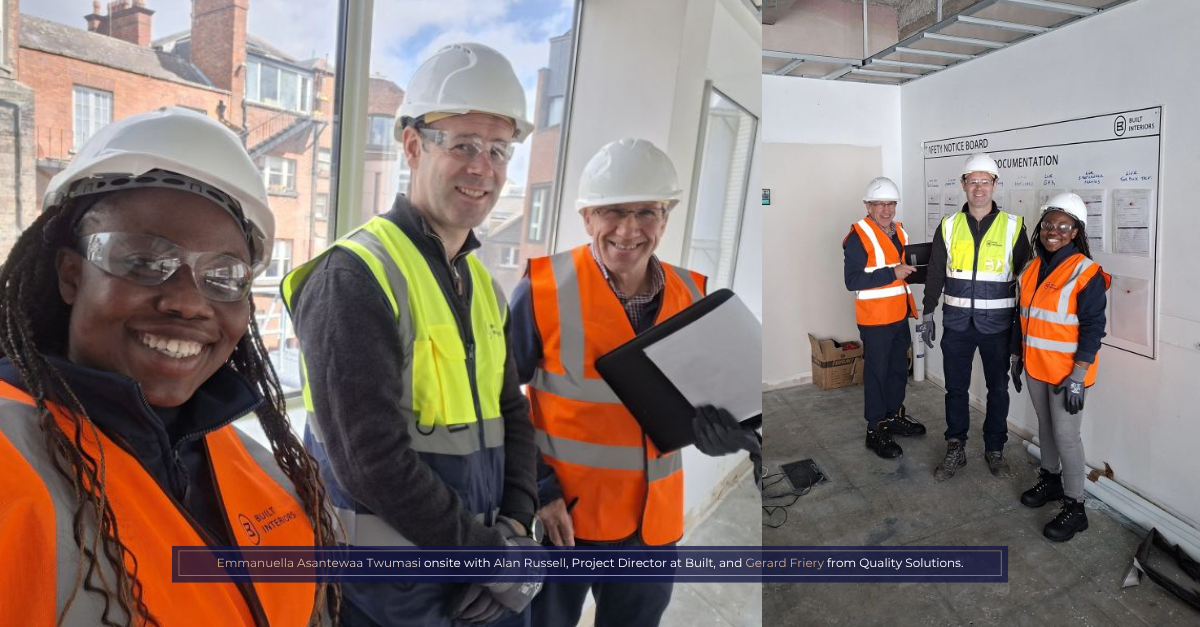
We have continued to strengthen sustainability within the BUILT360™ methodology. Six months ago, Emmanuella Asantewaa Twumasi joined our team as a Sustainability and Business Integration Coordinator, bringing additional focus to how sustainability is embedded into project delivery from pre-construction through to handover.
Many of these principles were already embedded into the delivery approach. Through tools such as point cloud surveying, BIM coordination and structured waste management, we reduce rework, improve efficiency and support better project outcomes. At 1 Le Pole Square, this approach contributed to a 98 per cent recycling rate and reduced material waste through careful planning and coordination.
However, the next step is to embed this thinking even further into the BUILT360™ methodology to create a more systematic framework for delivering high-performing, future-ready commercial environments.
You always know your client is happy when they ask you to design two more projects. We’ve just completed a second Liberty IT project in Galway and are commencing another project in Belfast .
Patrick Wilding
Design Lead, CBRE Design Collective
Delta Airlines
"Lorem ipsum dolor sit amet, consectetur adipiscing elit. Donec orci diam, lacinia ut massa tincidunt, faucibus commodo."
Walt Disney
Lorem ipsum dolor sit amet, consectetur adipiscing elit. Donec orci diam, lacinia ut massa tincidunt, faucibus commodo.
MetLife
Lorem ipsum dolor sit amet, consectetur adipiscing elit. Donec orci diam, lacinia ut massa tincidunt, faucibus commodo.
"You can't improve what you don't measure."
When Emmanuella started, she recognised that sustainability performance needed every detail, no matter how small or seemingly ‘insignificant’, documented and tracked.
"You can't make improvement if you cannot even measure how much waste you are generating," Emmanuella says.
Every sitestream is tracked back over a full year, with a clear site waste management plan in place to ensure waste diversion is properly controlled, plasterboard is separated from carpet tiles, aggregates and concrete are placed into dedicated skips, and metal waste is stored in designated skips on site, so nothing leaves a site without full documentation.
"From a compliance point of view, you have to be responsible to the end, the final destination of your waste." - Emmanuella Asentewaa
Building Systems to Manage Live-Building Risk
Over six months, Built achieved ISO certifications in health and safety (45001), quality (9001), and environmental (14001).
"It was a big achievement. It meant building a lot of systems," Emmanuella says.
That meant:
Equipment inspection records on every site
PAT testing for electrical tools before use
In-date safety supplies in site boxes
Proper PPE on every worker
Site inspections that check health, safety, environmental and quality metrics together
When a live retrofit is operating in an active building environment, the executional complexity increases significantly, as tenants remain in place and core building services must continue running throughout the works.
And these three standards work together to manage that operational reality.
ISO 45001 governs strict segregation and occupational health and safety controls to protect occupants and workers. ISO 9001 requires a “Right First Time” approach to process mapping, helping to reduce risk and avoid costly rework. ISO 14001 regulates environmental management, including hazardous waste handling and ensuring controlled, localized mitigation measures, often during out-of-hours working periods.
On current projects such as RCSI St. Stephen’s Green, Zara offices, and George’s Quay, Emmanuella is working to ensure these systems are fully embedded into the delivery programme and consistently implemented in practice.
“Is my property going to be relevant in ten years?"
There is a significant shift underway in what premium commercial clients are targeting when upgrading their assets. They’re targeting more than compliance, with their eye on A-class ratings (A3 to A1) or Zero-Emission Buildings (ZEB) standards to avoid stranded asset status and secure favourable green financing.
“As clients compared to the past are becoming more and more aware of the risk of their assets being stranded,” Emmanuella had observed. “They’re thinking: is my property going to be relevant in ten years? What do I need to do now? Will tenants still want to lease my assets?”
Today, most tender submissions include ESG criteria, and sustainability requirements are now a standard component across the majority of projects. “We need to talk about how we are going to help that project achieve sustainability, and that is mostly carrying bigger marks as well,” Emmanuella adds.
This connects directly to Building Energy Rating (BER) targets. Landlords are targeting higher BER ratings to remain compliant and commercially viable.
The Commercial Value of High-Standard Retrofits
Upgrading to a B2 or A-rated building: slashes operational expenditure through optimised HVAC, heat pump installation, and insulation. The savings compound annually.
High-BER assets: command higher lease rates. Blue-chip tenants with corporate net-zero mandates actively refuse to occupy low-rated buildings. Premium commercial clients are prepared to pay more per square metre for A-class or ZEB-compliant space.
Delivering a retrofit via an ISO 45001/9001/14001 certified supply chain: dramatically lowers the client's vicarious liability profile. Insurance premiums for both the asset and the project are frequently discounted when robust, auditable risk frameworks are in place.
It eliminates the risk of regulatory obsolescence: The asset remains liquid and highly valued in institutional markets well past the 2030/2033 EU climate milestones.
M&E Upgrades Aren't Standalone
When landlords upgrade mechanical, electrical, and plumbing (M&E) systems, the scope of work typically extends far beyond core building services. Projects often include refurbishing lift lobbies, upgrading lifts, reconfiguring bathrooms, adding showers, and integrating bicycle storage and electric vehicle charging points. Every element is interconnected, and each requires its own coordination and programme.
“A lot of the time, so many other works are going on beyond just the M&E works. These have to be managed. We can’t have different subcontractors just coming in and everybody doing their own works,” Emmanuella explains. “We need to know what needs to be done, and when, before the next stage.”
These complex projects require specialist interior fit-out contractor coordination to ensure performance goals are met across an occupied building. The M&E specialist alone cannot manage the operational, regulatory and commercial interfaces simultaneously.
We upgrade commercial real estate in challenging live environments
"Built Interiors has invested in a full-time sustainability resource because Built Interiors actually cares," Emmanuella says. “And usually, sustainability leads are only found in very large construction companies. Given the size of Built and their decision to invest in that role, it positions them strongly with clients.”
The BUILT360™ approach brings this together through a fully coordinated, end-to-end methodology for delivering complex live-environment upgrades.
Landlords looking to retrofit occupied buildings to meet targets, protect asset value, and deliver ESG-driven upgrades must balance compliance with long-term asset performance. Achieving higher Building Energy Ratings requires coordinated delivery, specialist oversight, and integrated programme management across all workstreams. Chat through the BUILT360™ methodology with Emmanuella and the Built team here.